
FONPLATA Participates in Event Promoting Biodiversity and Climate Adaptation Through Nature-Based Solutions
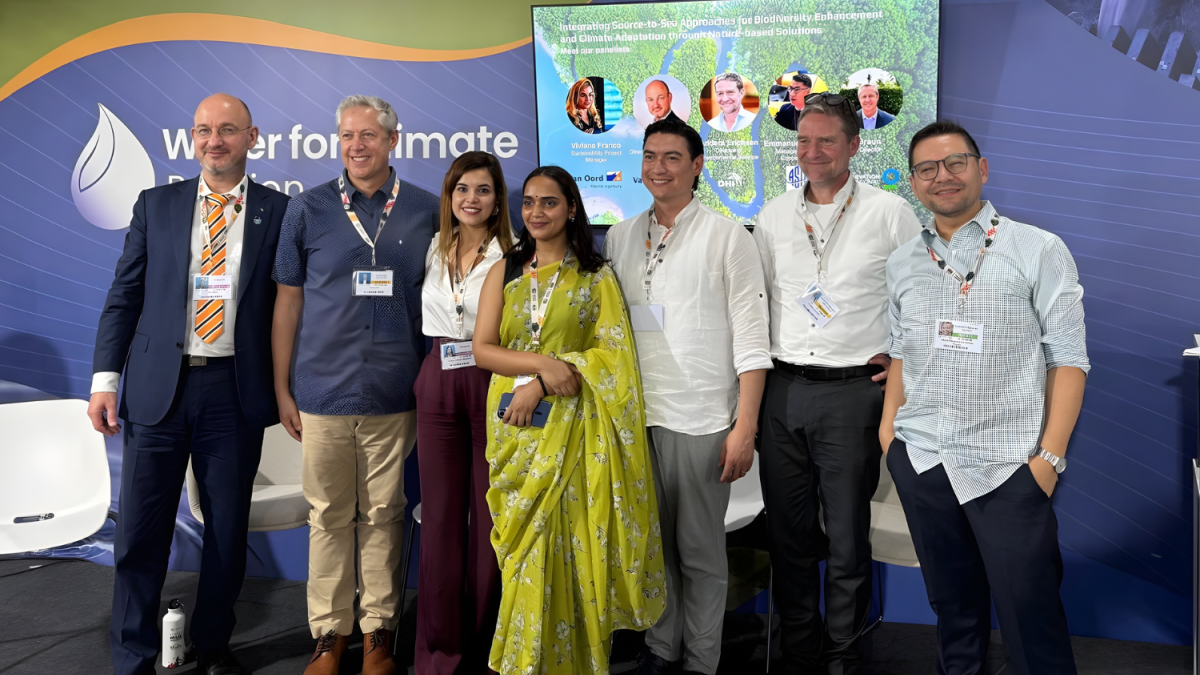
On November 13, FONPLATA’s Senior Specialist in Socio-Environmental Management, Miguel Fernández, represented the Bank in the panel “Integrating watershed-to-sea approaches to improve biodiversity and climate adaptation through nature-based solutions (NbS),” held at the Water for Climate Pavilion at COP30.
Organized by the Stockholm International Water Institute (SIWI), the event brought together international experts from organizations such as Van Oord, DHI, ASTM, and Conservation International. The discussion highlighted how connected ecosystems—from rivers and wetlands to mangroves and coastal areas—can be restored and protected through nature-based solutions, generating environmental, social, and economic benefits.
In this context, Fernández explained that FONPLATA is a regional development bank that works on the “first and last mile” of infrastructure, financing specific projects that transform the reality of cities and territories. He emphasized the importance of adopting a comprehensive approach that links watersheds with marine ecosystems, noting that “ecological restoration cannot be thought of in isolated compartments; we need solutions that recognize the interdependence between land and water, between communities and biodiversity.”
Using urban biodiversity as an example, the expert recalled MacArthur and Wilson's island biogeography theory, which shows that the size of islands and their connectivity influence species richness. Applied to the urban context, he pointed out that “linear parks, riverbank restoration, and the use of native species can improve ecological connectivity in cities and strengthen their resilience to climate change.”
The panel addressed specific cases of climate adaptation, including wetland restoration, integrated mangrove–aquaculture systems, and community-led models. Fernández stressed that, from a scientific perspective, “the past is no longer a reliable guide for the future.” This reality complicates the design of NbS in a context of accelerated climate change and high uncertainty, particularly in modeling convective storms and extreme events. From a management perspective, he underscored the challenge that administrative boundaries rarely align with watersheds, requiring new forms of coordination among municipalities, states, and countries.
The discussion also explored the challenges of scaling up these initiatives, such as the lack of technical standards, adequate funding, and intersectoral coordination. Fernández highlighted the need to “better synchronize public policy cycles, nature cycles, research timelines, and funding cycles”, which are key enablers of projects. Thus, scientific knowledge, political windows of opportunity, and financial resources align to support replicable and effective NbS.
He called for stronger partnerships among governments, communities, the private sector, and financial institutions to co-develop NbS models that are replicable, measurable, and sustainable. “At FONPLATA, we believe that investing in nature-based solutions is investing in resilience, equity, and the future,” he concluded, stressing that decision-making must be backed by solid evidence: “without data, we are walking blindly into the future.”
11/13/2025